Sites of Memories
By Abby Lawrence ’29
Graphics by Katy Su ’28
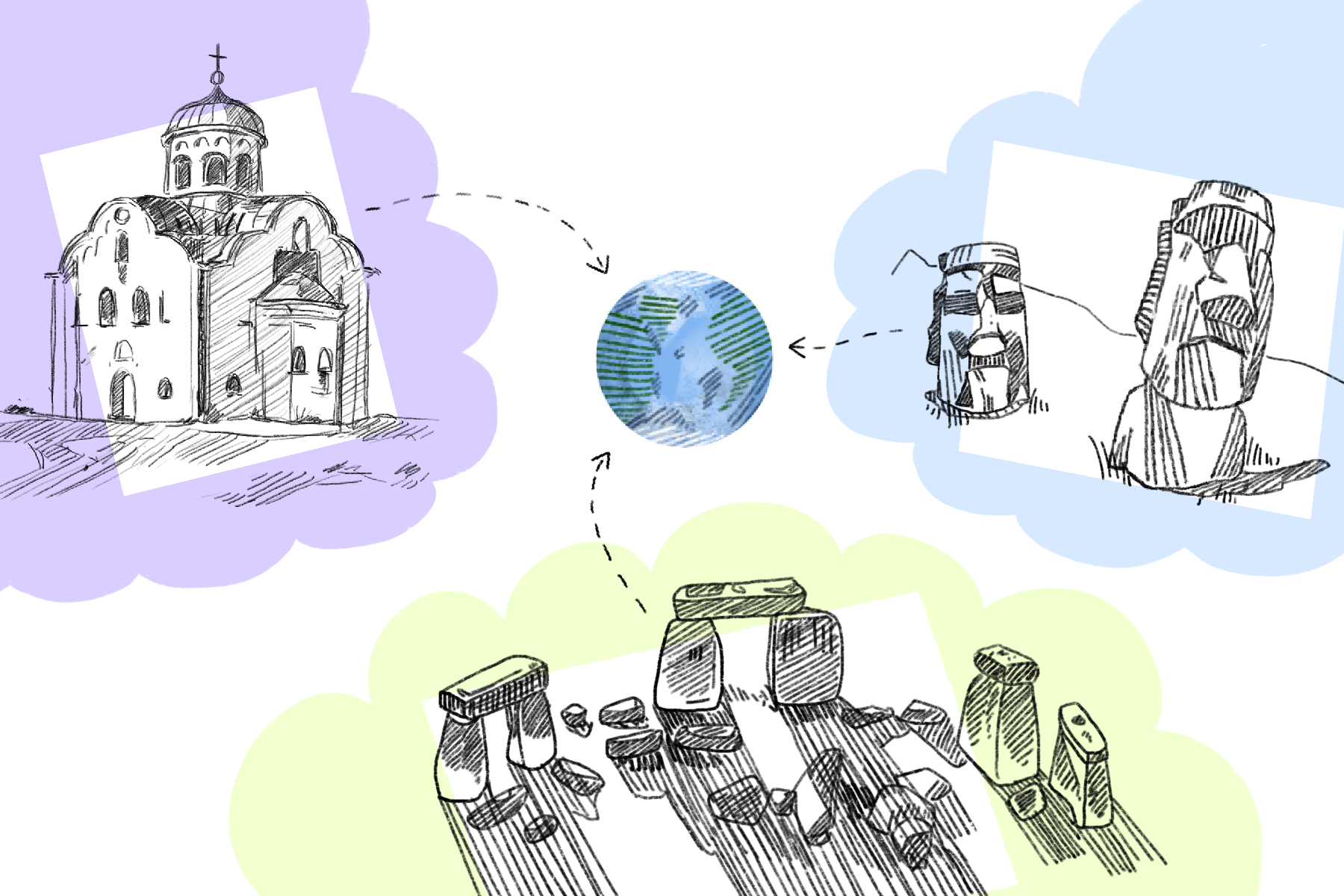
Lieux de mémoire, or “site of memory,” is a term coined by Pierre Nora, a French historian. This phrase describes any creation, physical or not, that has an associated meaning and significance. These sites embody what we choose and wish to remember, anchoring the original message to modern times as living memory fades. What is commemorated in a society is representative of the ideals and pride it has carried throughout history. It ensures that the standards of the community are remembered and upheld for recognition; however, tensions arise when the cultural norms of a society shift as time progresses. As the shift occurs, questions arise of who gets to decide what is brought into the new age and which version of history are we repeating.
Statues and monuments are very visible reminders of the past that have been erected and torn down for thousands of years. In Ancient Greece, many prominent monuments were created in support of religion and gods because those were the major themes in their society. This is very clearly demonstrated in all of the monuments created, like the statue of Zeus found in Olympia, Greece, dated to 430 CE. [1] When the Ancient Greeks constructed this, they not only wanted to show their devotion to their god but also aspired to display Zeus’s power so the citizens would remember which morals were honored. This notion of remembrance can be connected to the monuments still standing in the United States today. For instance, in Washington D.C., the capital, the Lincoln Memorial commemorates the 16th president and the freedom that is found in the U.S. This monument lets citizens remember the contributions he made, such as contributing to the abolition of slavery and the democracy that the country prides itself on. The differences between what was shown in the United States and ancient Greece reveal what is most important to the people.
Additionally, if we further examine the holidays that are celebrated, we can uncover the history we choose to acknowledge. Many people are worried about which side of history the United States should be on, and this has caused uproar around the country. Exemplified by the debate surrounding Columbus Day or the renaming of it to Indigenous Peoples’ Day. As of 2025, 221 cities have recognized the holiday as Indigenous Peoples’ Day instead, due to the heinous actions Christopher Columbus committed towards the Native community, while others want to keep the original name of the holiday and view him as a hero who discovered America. Citizens have shown their discontent with the idolization of Columbus by performing acts of protest where monuments relating to him are torn down. Such as when a Columbus statue was beheaded in Boston in 2020 because the community didn’t feel comfortable recognizing a man who displayed these horrific actions and reflected the discomfort with things that don’t align with contemporary values. [2] Similar problems have arisen around the country, as countless statues and different sites of memory have been vandalized in the name of tolerance and respect.
Ultimately, sites of memory not only can highlight creative expression but can also show multifaceted meanings such as devotion, pushing agendas, and celebrating the heroes of the past. While governments often control what is deserving of remembrance, the public is able to make real change happen when they contest the decisions made and stand together.
Footnotes
Tikkanen, “Statue of Zeus | Statue, Olympia, Greece.”
“Beheaded Christopher Columbus Statue in Boston Will Be Removed from North End Park.”
References
“Beheaded Christopher Columbus Statue in Boston Will Be Removed from North End Park.” n.d. Www.cbsnews.com. https://www.cbsnews.com/boston/news/christopher-columbus-statue-beheaded-boston-massachusetts/.
Chowdhry, Pritika. 2021. “What Are ‘Sites of Memory’ or ‘Lieux de Mémoires’?” Pritika Chowdhry Art. December 16, 2021. https://www.pritikachowdhry.com/post/sites-of-memory-lieux-de-memoires.
National Park Foundation. n.d. “Lincoln Memorial.” National Park Foundation. https://www.nationalparks.org/explore/parks/lincoln-memorial.
Tikkanen, Amy. 2019. “Statue of Zeus | Statue, Olympia, Greece.” In Encyclopædia Britannica. https://www.britannica.com/topic/Statue-of-Zeus.
Tufts, John, Chris Sims, and Katie Wiseman. 2025. “What’s Closed on Columbus Day? What Is Indigenous Peoples’ Day?” The Courier-Journal. Louisville Courier Journal. 2025. https://www.courier-journal.com/story/entertainment/events/2025/10/11/what-did-trump-say-about-columbus-day-2025-indigenous-peoples-day-is-there-mail/86626609007/.