What to Remember
By Justin Kim ’28
Graphics by Katy Su ’28
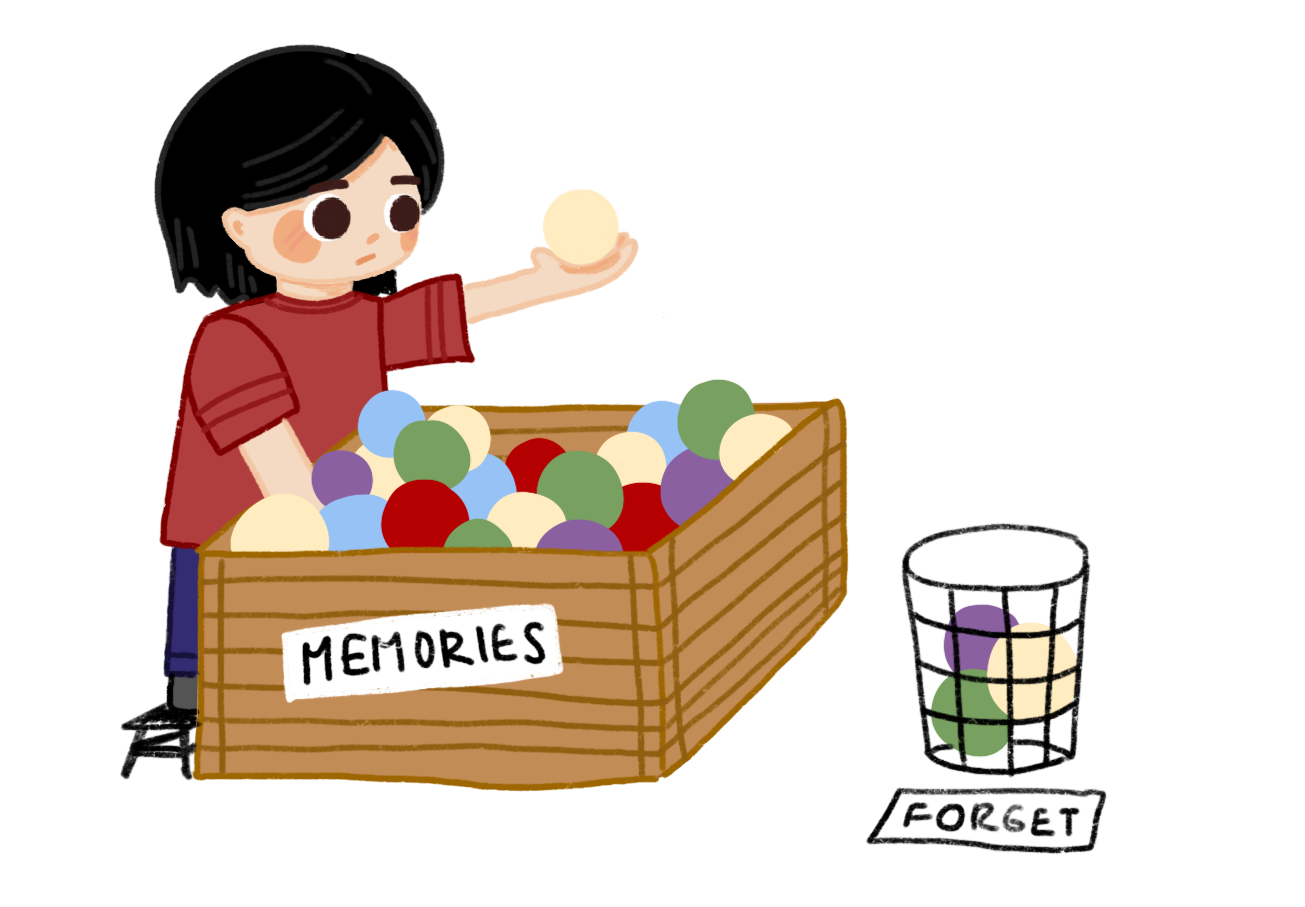
One survey has shown that one in three people can not remember their emergency contact numbers. [1] With the rise of the digital era, humans are becoming more reliant on search engines and digital memory. Digital memory, stored online by search engines, can hold nearly unlimited, searchable information and is readily available within a few clicks. Due to the rise of digital memory, humans, believing that searchable information is part of their knowledge, are starting to forget information they know they can easily find online. Compared to digital memory, human memory is more limited and selective, only keeping information we believe is useful. [2] That’s why we don’t remember what we did on a random Tuesday four years ago, but we remember our first day of school.
This reliance on digital memory is known as the “Google Effect,” our tendency to look for information rather than remembering the information itself. Research has shown that when people know they have access to information, they are less likely to commit to memorizing it. [3] As a result, this is changing how we remember things. Instead of remembering the fact itself, we remember how to get there. We know our contacts will have the phone numbers of our loved ones, and Google will remember detailed facts for us.
Some believe that this reliance on digital memory leads to a decrease in the ability to digest information and attention spans, weakening our cognitive abilities. [4] On the other hand, knowing you will have access to trivial details not only quickens access to information but also opens space for other memories in our brains. Additionally, technology has been advancing rapidly, so it is not a matter of whether or not we can stop this phenomenon. Rather, it’s about what we can bring, given that digital memory will continue to grow as a companion.
One of the skills that is becoming increasingly crucial in the digital world is the ability to interact effectively with digital memory in ways that yield the information that you seek. All the stored data is useless if you do not know how to retrieve what you need from it. Additionally, learning how to discern bias and misinformation is another valuable skill. With the rise of AI, misleading information, photos, and videos are being created. Knowing how to verify a fact is often more important than knowing the fact itself.
The Google Effect does indeed come with some risks. We might skim information after looking it up just to see and forget, instead of fully learning it. Or we might blur the line between understanding and recognizing after viewing it online once. However, these risks can be combated with some simple habits. Instead of accepting the first source Google offers, we can cross-check with other sources. Before accepting a claim as factual, we ought to interpret and explain it in our own words. Just like any other societal change, there are some challenges we will have to face with the rise of technology. However, it’s not entirely negative.
Digital memory can do us a favor by clearing space in our minds. With the correct skills and habits, we could use our memory to prioritize what is truly meaningful to us, things that can’t be stored online. Whether it’s creativity, time with loved ones, or deep thinking that doesn’t just end with a fact, there are important things to us that we want space in our minds for. It is true that we can’t stop the Google Effect, but we can use it as an opportunity to decide what takes priority in our minds. Let your phone remember your friend’s birthday, and spend time on the laughter and memories at the birthday party instead. The goal isn’t to remember everything and reject the Google Effect, but it’s to protect what we really value: time, memory, and skills that no search engine can replace.
Footnotes
Collins, “How Many Phone Numbers Do You Know by Heart? Turns out We Can’t Recall.”
Cleveland Clinic, “Memory: What It Is, How It Works & Types.”
Gong, Chen, and Yang Yang,“Google Effects on Memory: A Meta-Analytical Review of the Media Effects of Intensive Internet Search Behavior,” 12.
The Decision Lab, “Why Do We Forget Information That We Just Looked Up?”
References
BetterHelp Editorial Team. 2025. “An Overview of Selective Memory | Betterhelp.” www.betterhelp.com. April 18, 2025. https://www.betterhelp.com/advice/memory/an-overview-of-selective-memory/.
Bilal, Mohd. 2025. “The Internet vs Human Memory: Who Will Last Longer?” Medium. February 10, 2025. https://mohdbilal12.medium.com/the-internet-vs-human-memory-who-will-last-longer-821c206c7645.
Cleveland Clinic. 2024. “Memory: What It Is, How It Works & Types.” Cleveland Clinic. Cleveland Clinic. September 16, 2024. https://my.clevelandclinic.org/health/articles/memory.
Collins, Terry. 2022. “How Many Phone Numbers Do You Know by Heart? Turns out We Can’t Recall.” USA TODAY. August 3, 2022. https://www.usatoday.com/story/tech/2022/07/13/memorizing-numbers-smartphone-iphone/10036000002/.
Community Neuroscience Services. 2025. “Technology’s Impact on Memory: Are We Forgetting How to Remember? - Neuro Science.” Neuro Science. July 9, 2025. https://communityneuroservices.com/technologys-impact-on-memory-are-we-forgetting-how-to-remember/.
Gong, Chen, and Yang Yang. 2024. “Google Effects on Memory: A Meta-Analytical Review of the Media Effects of Intensive Internet Search Behavior.” Frontiers in Public Health 12 (12). https://doi.org/10.3389/fpubh.2024.1332030.
The Decision Lab. 2021. “Why Do We Forget Information That We Just Looked Up?” The Decision Lab. 2021. https://thedecisionlab.com/biases/google-effect.