Art as Memory
By Grace Yi ’29
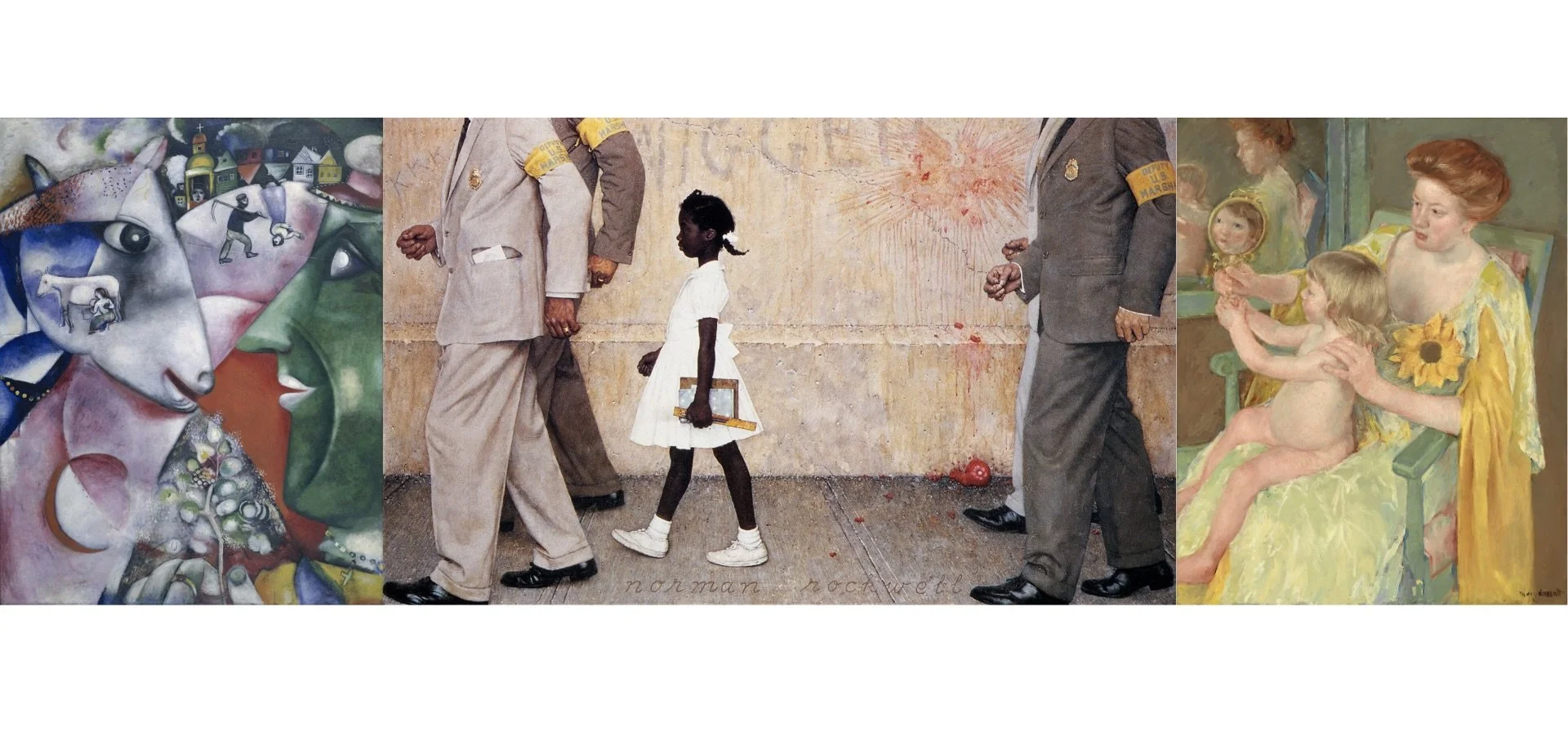
I and the Village (Left), The Problem We All Live With (Center), Woman With A Sunflower (Right)
Art is memory, regardless of medium, subject, or theme. Artists express themselves through art, and artists are shaped by cultural ideas of their time. Because of that, art is a reflection of both personal and cultural memory. This article will cover three art pieces, and through those three pieces, we can start to recognize the personal and cultural memory in art.
I. Marc Chagall, I and the Village (1911).
A lamb and a green man gaze at each other as the man holds up a flowering branch. In the top-right corner sits a village with a line of houses, a church, and two people; some are even upside-down. Atop the lamb’s cheek, a maiden milks a cow. Chagall painted this dream-like landscape one year after moving to Paris from his childhood town (located in present-day Belarus). [1] In Paris, Chagall was introduced to the Cubist art movement. Those influences shone through “I and the Village” with its usage of vibrant colors, bright imagination, and (blank) shapes. [2] Chagall also blended Cubism with Jewish symbols, such as the lamb and the cow. Chagall, by incorporating his Jewish background with Cubism, retained the memory of his childhood, the broader Jewish community, and the influences of the art movement.
II. Norman Rockwell, The Problem We All Live With (1963).
This painting was created during the height of the Civil Rights movement. [3] Norman Rockwell was very well known for his illustrations on Saturday Morning Post and for illustrating nostalgic “ideal” American life. [4] However, as the civil rights movement progressed, Rockwell’s themes shifted as well. In 1960, Ruby Bridges was one of those first black children to be integrated into a white school. [5] However, the public did not take this lightly; many protested over having their white children sit next to a black girl. However, Rockwell found Ruby’s story inspiring. [6] The painting focuses on young Bridges, walking bravely and unyieldingly. Even while being surrounded by racist graffiti and a thrown tomato, Bridges is shown keeping her poise while walking to school. Later on, The Problem We All Live With was displayed in the White House to commemorate Bridges and the other black students. [7] Clearly, Rockwell’s painting of Bridges preserves the fight for equality and a vital moment of the Civil Rights movement.
III. Mary Cassatt, Woman with a Sunflower (1905).
The painting displays a woman and a child together; the mother carries the child and is teaching her how to hold a mirror. Additionally, the mother has a sunflower bloom on her dress. While this painting may appear commonplace, it captures an intimate mother-child bond, and the symbolism within this bond reflects the suffragette movement. For example, while the mirror symbolizes society trying to contain women, Cassatt encourages women to go against those expectations and view themselves differently from society’s perceptions. Additionally, the sunflower was a prominent universal symbol throughout the American Suffrage Movement. [8] Clearly, Cassatt conveys a very powerful message through the use of her metaphors, allowing the fight for women’s suffrage to still be remembered.
In conclusion, even though these paintings were made in different time periods, all three of these artworks convey the theme of memory. All three of these paintings preserve sociopolitical landscapes and identity through the artists’ lens. These paintings also encapsulated the artists’ self-expression and even personal memory. Let it be understood, too, that there is an uncountable amount of art in the world throughout history. These three artworks are only a fraction of possible examples. But undoubtedly, through these pieces, art was used as a tool of preserving memory, and it is still being used as one today.
Footnotes
MoMA. 2019. “I and the Village.” (The Museum of Modern Art. MoMA. 2019.) https://www.moma.org/collection/works/78984.
“I and the Village, 1911 by Marc Chagall.” 2009. (Marcchagall.net. 2009.) https://www.marcchagall.net/i-and-the-village.jsp.
“I and the Village, 1911 by Marc Chagall.”
Pastan, Amy. 2022. “Norman Rockwell + the Problem We All Live With.” (The Kennedy Center. January 31, 2022.) https://www.kennedy-center.org/education/resources-for-educators/classroom-resources/media-and-interactives/media/visual-arts/norman-rockwell--the-problem-we-all-live-with/.
Clayborne Carson. 2025. “American Civil Rights Movement.” In Encyclopedia Britannica. (Britannica.) https://www.britannica.com/event/American-civil-rights-movement.
Pastan, “Norman Rockwell + the Problem We All Live With.”
Pastan, “Norman Rockwell + the Problem We All Live With.”
“Woman with a Sunflower by Mary Cassatt.” 2025. (National Gallery of Art. 2025.) https://www.nga.gov/artworks/46573-woman-sunflower.
References
Carson, Clayborne. 2025. “American Civil Rights Movement.” In Encyclopedia Britannica. Britannica. https://www.britannica.com/event/American-civil-rights-movement.
“I and the Village, 1911 by Marc Chagall.” 2009. Marcchagall.net. 2009. https://www.marcchagall.net/i-and-the-village.jsp.
MoMA. 2019. “I and the Village.” The Museum of Modern Art. MoMA. 2019. https://www.moma.org/collection/works/78984.
“Norman Rockwell Museum - Digital Collection.” n.d. Collection.nrm.org. https://collection.nrm.org/#details=ecatalogue.47483.
Pastan, Amy. 2022. “Norman Rockwell + the Problem We All Live With.” The Kennedy Center. January 31, 2022. https://www.kennedy-center.org/education/resources-for-educators/classroom-resources/media-and-interactives/media/visual-arts/norman-rockwell--the-problem-we-all-live-with/.
“Woman with a Sunflower by Mary Cassatt.” 2025. National Gallery of Art. 2025. https://www.nga.gov/artworks/46573-woman-sunflower.